
How to Build a YouTube Channel Network in 2026: A Practical Guide for Organic Traffic
YouTube is no longer just a place to upload videos and wait for views. In 2026, it works more like a full media ecosystem: Shorts, long-form videos, livestreams, podcasts, shopping, community posts, and creator-led brands all live inside one platform.
For affiliate marketers, media buyers, content teams, and solo creators, this creates a clear opportunity: instead of relying on one channel, you can build a small network of YouTube channels around different niches, formats, or traffic goals.
But there is one important rule: a YouTube channel network should not be a spam farm. The old model of uploading repetitive videos at scale, copying content, or using templated AI clips is risky. YouTube’s monetization policies now clearly warn against mass-produced, repetitive, or low-value content, especially when it looks like it was made from the same template again and again.
A sustainable YouTube network in 2026 is not about quantity alone. It is about building several focused content assets that attract real viewers, earn trust, and send traffic to the right offer, website, product, or funnel.
What Is a YouTube Channel Network?
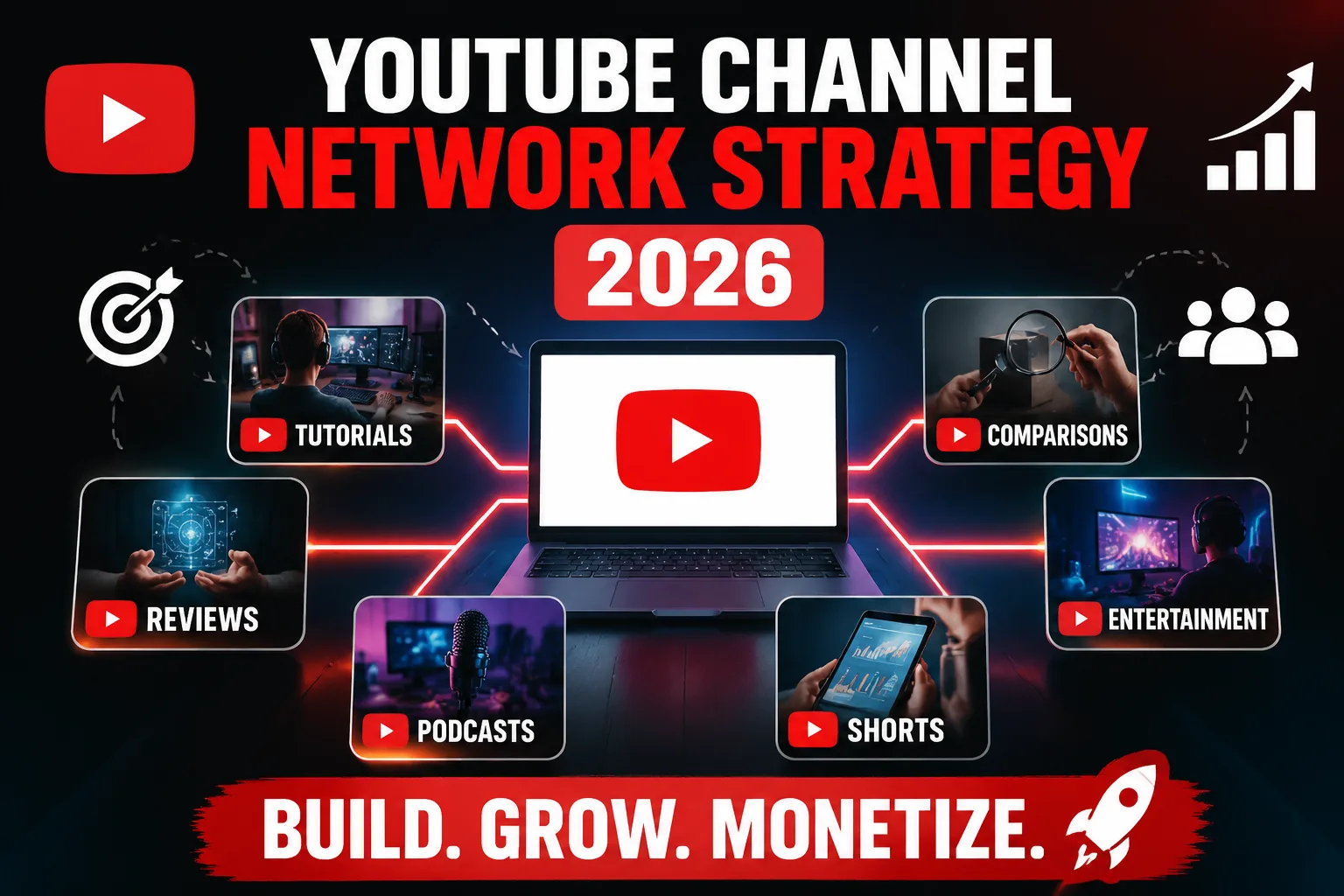
A YouTube channel network is a group of channels managed under one strategy. Each channel usually has its own niche, audience, content angle, and traffic purpose.
For example, one team may run:
-
a product review channel;
-
a Shorts channel for viral discovery;
-
a tutorial channel for search traffic;
-
a comparison channel for affiliate offers;
-
a brand channel for authority and trust.
The key idea is separation. Instead of mixing every topic into one messy channel, each channel serves a specific user intent.
This matters because YouTube audiences are expectation-driven. Someone who subscribes for software tutorials may not want gambling content, crypto news, or random entertainment clips in the same feed. A channel network lets you build cleaner positioning.

Why Channel Networks Still Matter in 2026
The main advantage of a YouTube channel network is traffic diversification.
If one channel slows down, another can keep growing. If one niche becomes too competitive, another may still have room. If one format fails, another format can reveal what the audience actually wants.
In 2026, this is especially important because YouTube is expanding across formats. Shorts now average 200 billion daily views, while long-form videos, podcasts, livestreams, and TV viewing continue to grow inside the same platform.
That means creators and marketers should not think only in terms of “one channel = one strategy.” A better approach is to build a small portfolio:
-
Shorts for reach;
-
long-form videos for trust;
-
tutorials for search demand;
-
comparisons for buyer intent;
-
community posts for retention;
-
live formats for loyalty.
The network model helps you test all of these without damaging the positioning of one main channel.
The Safe Way to Plan a YouTube Network
Before creating multiple channels, define the business logic behind them.
A weak strategy looks like this:
“We will create many channels and upload as much content as possible.”
A stronger strategy looks like this:
“We will create three channels for three different audience intents: beginners, buyers, and advanced users.”
That difference is important.
YouTube’s rules do not ban similar formats or repeatable production workflows. However, YouTube does care whether each video brings real value and whether the content is materially different from video to video.
So the first step is not automation. The first step is mapping audience intent.

Example of a clean channel map
A software affiliate project could divide its YouTube network like this:
Channel 1: Educational search traffic
Videos like “How to use a CRM for small business” or “Best project management tools for agencies.”
Channel 2: Product comparisons
Videos like “Tool A vs Tool B” or “Best email marketing software for beginners.”
Channel 3: Shorts and quick tips
Short videos with fast use cases, mistakes, myths, and simple explanations.
Each channel has a different job. Together, they create a traffic system.
Choosing Niches: Do Not Start With the Offer
Many affiliate marketers make the same mistake: they start with the offer, not the audience.
For example, they pick a high-payout affiliate program and immediately create content around it. This can work for a short time, but it often produces thin, generic content.
A better process is:
-
Find an audience with repeated problems.
-
Study what they search for on YouTube and Google.
-
Identify what type of video helps them make a decision.
-
Match offers only after the content angle is clear.
This is how you avoid turning your channel into a pure traffic bridge. YouTube does not reward content that exists only to push users off-platform, especially if it looks spammy or deceptive. Its spam policy covers coordinated networks, artificial engagement, repetitive comments, off-platform diversion, and automated mass production.
A healthy niche has three signals:
-
people search for answers regularly;
-
the topic can be explained visually;
-
viewers can naturally move from the video to a product, service, website, or newsletter.
Good examples include software tutorials, finance education, gaming guides, home improvement, health and fitness education, travel planning, career advice, and product comparisons.
Content Formats That Work Well in a Channel Network
A YouTube network should not rely on one format only. Different formats solve different problems.
1. Search-based tutorials
These videos answer direct questions. They are useful for long-term organic traffic.
Examples:
-
“How to set up email automation”
-
“How to choose a VPN for travel”
-
“How to edit videos on a budget”
The main benefit is stability. A good tutorial can bring views for months or years.
2. Comparison videos
Comparison content works well for affiliate marketing because the viewer is already close to making a decision.
Examples:
-
“Best AI writing tools for bloggers”
-
“Platform A vs Platform B”
-
“Cheapest hosting for a new website”
The value must be real. Do not just repeat product descriptions. Add criteria, pros and cons, use cases, and clear recommendations.
3. Shorts for discovery
Shorts can introduce a channel to new audiences quickly. They are useful for simple insights, mistakes, myths, and hooks.
However, Shorts should not be treated as disposable spam. The best Shorts have a clear idea, fast pacing, and a reason for the viewer to continue watching your other content.
4. Explainer videos
Explainers are perfect for beginners. They build trust because they simplify a topic before selling anything.
Examples:
-
“What is affiliate tracking?”
-
“What is media buying?”
-
“How does YouTube monetization work?”
5. Case-study videos
Case studies are powerful because they show proof. Even small experiments can become good content if the process is transparent.
Examples:
-
“We tested three thumbnails for one video”
-
“What happened after posting Shorts for 30 days”
-
“How one tutorial generated affiliate clicks”
AI and Automation: Useful, but Not a Content Strategy
AI can speed up research, scripting, translation, subtitles, thumbnails, and editing. In 2026, YouTube itself is investing heavily in AI tools for creators, including content assistance, auto-dubbing, and new creative formats.
But AI should support the channel, not replace the editorial idea.
The risky version of AI content looks like this:
-
same voice;
-
same stock footage;
-
same script structure;
-
same generic visuals;
-
no original opinion;
-
no real editing logic;
-
mass-uploaded across many channels.
The safer version looks like this:
-
human topic selection;
-
original examples;
-
useful commentary;
-
visible editorial structure;
-
different scripts for different audience needs;
-
real comparison, testing, or explanation.
YouTube’s policy specifically warns against generic AI templates that look mass-produced and do not add authentic insight or perspective.
So the practical rule is simple: use AI to produce faster, not to think less.
How to Connect Multiple Channels Without Looking Spammy
A channel network can support itself, but cross-promotion must feel natural.
Good cross-promotion:
-
links from a beginner video to an advanced tutorial;
-
sends viewers from Shorts to a full guide;
-
recommends a related playlist;
-
uses a brand hub or website as the central destination;
-
connects channels only when topics are genuinely related.
Bad cross-promotion:
-
identical comments across many videos;
-
fake engagement between channels;
-
repeated “subscribe to my other channel” messages;
-
irrelevant links in every description;
-
channels created only to push traffic to one landing page.
YouTube’s spam policy includes comment spam, artificial engagement, and coordinated low-quality behavior, so network growth should be based on viewer value, not manipulation.
Think of your network like a group of websites under one media company. They can support each other, but each one must be useful on its own.
Metrics to Track Across a YouTube Channel Network
When you manage several channels, vanity metrics are not enough. Views matter, but they do not tell the full story.
Track metrics by channel role.
For a Shorts channel, watch:
-
retention;
-
replay rate;
-
subscriber conversion;
-
clicks to long-form content.
For a tutorial channel, watch:
-
search impressions;
-
average view duration;
-
click-through rate;
-
comments with questions;
-
traffic to links.
For an affiliate comparison channel, watch:
-
clicks on tracked links;
-
conversion rate;
-
revenue per video;
-
ranking stability;
-
audience trust signals.
The goal is not to make every channel perform the same way. The goal is to understand what each channel is supposed to do inside the larger system.
Common Mistakes When Building YouTube Channels at Scale
The biggest mistake is treating YouTube like a volume game only.
More videos can help, but only when the content quality stays consistent. Uploading hundreds of similar videos with minimal changes can damage monetization potential and reduce trust.
Another mistake is mixing too many niches. A channel about tech reviews, casino offers, celebrity news, and travel tips will confuse both viewers and the recommendation system.
A third mistake is ignoring compliance. If your channel depends on copied clips, scraped content, misleading thumbnails, or low-effort AI output, the traffic may not last.
The final mistake is having no funnel. Organic views are valuable, but they need a purpose. A viewer should know what to do next: watch another video, join a newsletter, compare products, visit a website, or test a tool.
A Simple 2026 Workflow for Launching a YouTube Network
Start small. A network does not need ten channels on day one.
A practical launch plan could look like this:
Month 1: Research and positioning
Choose two or three audience segments. Build a keyword map. Study competitors. Define the purpose of each channel.
Month 2: Content testing
Publish different formats: tutorials, Shorts, comparisons, explainers. Do not scale before you know what works.
Month 3: Optimization
Improve thumbnails, titles, intros, descriptions, playlists, and internal links. Track which videos bring subscribers, clicks, and conversions.
Month 4: Scaling
Only after finding repeatable winners, increase publishing volume. Add editors, scriptwriters, or AI-assisted workflows, but keep quality control human.
This approach is slower than mass uploading, but it is safer and more stable.
Conclusion: Build a Media System, Not a Spam Network
A YouTube channel network can still be a strong organic traffic strategy in 2026. But the rules of the game have changed.
The winning model is not about flooding YouTube with repetitive videos. It is about creating a focused portfolio of channels where each one serves a specific audience, format, and business goal.
For example, an affiliate team promoting software could build one channel for tutorials, one for comparisons, and one for Shorts. Together, these channels can attract beginners, help buyers make decisions, and move warm traffic to a website or offer.
The main principle is simple: every channel must be able to stand alone as a useful content asset. If the network creates real value, YouTube becomes more than a traffic source — it becomes a long-term media engine.