
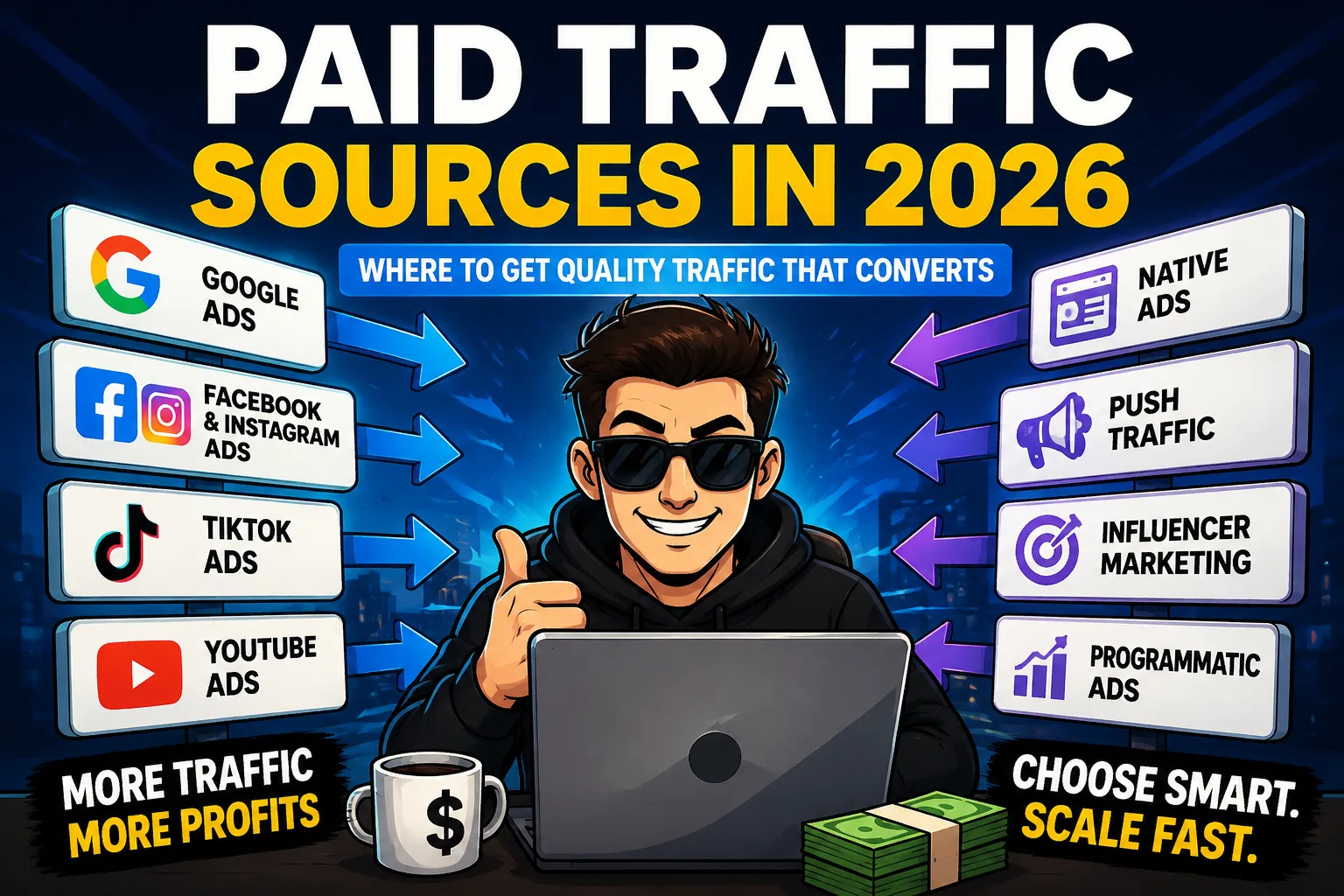
Paid Traffic Sources in 2026: How to Choose the Right Channel for Affiliate Marketing and Online Growth
Paid traffic is no longer just a list of ad networks where you can buy clicks. In 2026, it is a system of channels, formats, algorithms, creatives, compliance rules, and funnel logic. The same offer can perform completely differently depending on whether you launch it through search ads, social media, native placements, push notifications, influencer integrations, or programmatic display.
This guide explains the main types of paid traffic sources, how they work, where they fit in the funnel, and how beginners can choose a starting point without wasting the entire budget on random tests.
Why Paid Traffic Still Matters in 2026
Organic traffic is valuable, but it takes time. SEO, content marketing, communities, and brand building can work well, yet they rarely give instant volume. Paid traffic solves a different task: it helps you test an offer, collect data, validate creatives, and scale a working funnel faster.
The key difference in 2026 is that media buying has become more automated. Platforms such as Google Ads, Meta Ads, TikTok Ads, and Microsoft Advertising rely heavily on machine learning, automated bidding, broad targeting, and conversion signals. That means the traffic buyer’s role has changed: instead of manually controlling every small setting, you need to provide the system with strong creatives, clean tracking, enough conversion data, and a clear business goal.
For affiliate marketers, this creates both opportunity and risk. Automation can scale campaigns quickly, but it can also spend money quickly if the offer, landing page, tracking, or compliance setup is weak.
Start with Intent: Search and Contextual Advertising
Search traffic is one of the most practical channels because it captures existing demand. Users are already looking for a product, service, review, comparison, or solution. This makes search ads especially useful for offers where people understand the problem and are actively searching for an answer.
Google Ads
Google Ads remains one of the strongest paid traffic sources for high-intent users. Its campaign types cover search, display, shopping, video, app promotion, and automated campaign formats. Google’s own guidance recommends choosing a campaign type based on the advertiser’s marketing goal, brand strategy, and available time for campaign management.
For affiliates and online businesses, Google Ads works best when the offer is compliant, the landing page is transparent, and the keyword intent is clear. Examples include software, financial comparison pages, local services, e-commerce, education, B2B tools, and legal lead generation.
The main advantage is quality of intent. The main disadvantage is strict moderation and competition on profitable keywords. Beginners should avoid launching broad campaigns immediately. A safer approach is to start with narrow keyword clusters, clear negative keywords, and one landing page per search intent.
Microsoft Advertising
Microsoft Advertising is often underestimated, but it can be useful for search-first campaigns, especially in markets where Bing, Edge, Windows, Outlook, and Microsoft’s ecosystem have strong reach. Microsoft lists multiple ad formats, including app install ads, dynamic search ads, audience ads, multimedia ads, and other search or audience-based formats.
The practical value is that competition may be lower than on Google in some niches. It can be a smart second source after a campaign already works on Google Search. For B2B, finance, software, and older purchasing audiences, Microsoft Advertising deserves testing.
When Search Traffic Is the Best Choice
Search is a strong fit when users already know what they want. It is weaker when you need to create demand from scratch. If nobody is searching for your product category, social, native, video, or influencer traffic may work better.
A simple rule: use search ads when the user has intent; use social or native ads when you need to generate curiosity.
Use Social Platforms for Demand Creation
Social platforms are not only traffic sources. They are attention markets. People do not open Instagram, Facebook, TikTok, Snapchat, Pinterest, or Reddit to buy something immediately. They come to scroll, watch, react, compare, and discover.
That is why social traffic depends heavily on creative quality. The ad must interrupt the feed naturally, explain the benefit quickly, and match the platform culture.
Meta Ads: Facebook and Instagram
Meta Ads is still one of the most universal paid traffic sources because it combines large audience reach, visual formats, retargeting options, lead forms, and conversion campaigns. Meta’s official ad objectives include goals such as awareness, traffic, engagement, leads, app promotion, and sales.
Meta works well for e-commerce, lead generation, mobile apps, local services, info products, beauty, fashion, fitness, home goods, and many white-hat affiliate offers. It is also strong for retargeting because users often need several touches before converting.
The challenge is creative fatigue. A campaign can perform well for a few days and then decline when the audience stops reacting. In 2026, successful Meta buying is less about finding one perfect targeting setting and more about building a creative testing machine: hooks, angles, UGC-style videos, static ads, carousels, testimonials, before/after logic where allowed, and landing-page alignment.
TikTok Ads
TikTok Ads is built around fast creative testing and short-form video. TikTok’s official help center describes advertising objectives across categories such as awareness, consideration, and conversion-oriented goals.
TikTok can be powerful for trend-driven products, apps, beauty, lifestyle, gaming, gadgets, fashion, entertainment, education, and impulse-driven offers. The platform rewards native-looking content more than polished corporate ads. A video that feels like a real recommendation, demo, challenge, or story often performs better than a traditional banner-style creative.
For beginners, TikTok is attractive because you can test many angles quickly. But it also requires constant creative production. One or two videos are usually not enough.
Reddit, Snapchat, Pinterest, X, and Niche Social Ads
Smaller or more specialized social platforms can be useful when the audience fit is clear. Reddit is strong for interest-based communities and discussion-driven niches. Pinterest works well for visual discovery, lifestyle, home, fashion, weddings, design, food, and shopping inspiration. Snapchat can be relevant for younger audiences, entertainment, mobile apps, and quick-consumption offers. X can work for finance, crypto, SaaS, tech, politics, media, and founder-led brands, but performance depends heavily on audience quality and offer fit.
The benefit of these platforms is less saturated attention. The risk is lower volume or less predictable conversion quality compared with Google, Meta, and TikTok.
Native Advertising: Selling Through Curiosity
Native ads appear inside content environments: news sites, blogs, recommendation widgets, advertorial placements, and publisher networks. They are designed to look less like direct ads and more like content suggestions.
Native traffic is useful when the offer requires explanation. Instead of sending users directly to a checkout page, advertisers often use a pre-landing page, quiz, story, review, comparison, or educational article.
This format can work for health and wellness, finance, insurance, beauty, anti-aging, gadgets, home improvement, dating, sweepstakes, and other verticals where storytelling improves conversion. However, many sensitive niches have strict rules. Claims must be controlled carefully, especially in health, finance, and legal topics.
The best native funnels usually follow this logic:
Attention → curiosity → explanation → trust → call to action.
Native traffic is not about shouting “buy now.” It is about making the user feel that the next click is useful.
Push, Pop, Redirect, and Domain Traffic: Cheap Volume with Higher Risk
Some paid traffic sources focus on low-cost volume rather than premium intent. These include push notifications, in-page push, popunder, clickunder, redirect traffic, expired-domain traffic, and similar formats.
They are popular in affiliate marketing because they can generate many visits quickly. They may work for sweepstakes, dating, apps, downloads, utilities, antivirus-style offers, gambling where allowed, crypto where compliant, and simple lead-gen flows.
The advantage is price. The disadvantage is quality. Many users did not actively search for the offer, so conversion rates can be low. Fraud filtering, bot detection, frequency control, blacklists, whitelists, and strict tracking are essential.
For beginners, these sources are tempting because the entry budget can be lower. But cheap traffic is not automatically profitable traffic. If you cannot track zones, placements, devices, browsers, countries, and conversion events properly, you can burn money fast.
Video and CTV: From Direct Response to Brand Lift
Video traffic has expanded far beyond YouTube. In 2026, advertisers can buy video placements through YouTube, TikTok, Meta Reels, Snapchat, programmatic video, streaming platforms, and connected TV inventory.
Video is effective because it demonstrates the product instead of simply describing it. It can show the problem, the transformation, the proof, and the call to action in one short sequence.
For performance campaigns, short videos usually need three elements:
-
A strong hook in the first seconds.
-
A clear problem-solution bridge.
-
A simple next step.
YouTube is especially useful when users are researching, learning, comparing, or watching reviews. TikTok and Reels are better for fast discovery and emotional engagement. CTV can support awareness and retargeting, but it usually requires stronger budgets and better attribution discipline.
Marketplaces and Retail Media: Paid Traffic Close to Purchase
Retail media has become one of the most important paid traffic categories. Instead of advertising only on social feeds or search engines, brands can buy placements inside marketplaces and retail ecosystems where users are already shopping.
Examples include Amazon Ads, Walmart Connect, eBay Ads, Etsy Ads, Instacart Ads, and other marketplace advertising tools. These sources are especially useful for physical products, private-label brands, consumer goods, supplements where compliant, electronics, home goods, pet products, and beauty.
The biggest advantage is purchase intent. The user is already in shopping mode. The main limitation is that you often compete directly inside the marketplace, where reviews, price, delivery speed, product images, and ratings influence performance as much as the ad itself.
For e-commerce, retail media should not be treated as “just another traffic source.” It is a product-ranking and conversion system. Ads can bring visibility, but the listing must be strong enough to convert.
Programmatic, Display, and Retargeting: Scaling Beyond One Platform
Display and programmatic advertising allow advertisers to buy banner, video, and native-like placements across many websites and apps. This category includes demand-side platforms, ad exchanges, direct publisher deals, and retargeting networks.
Display is rarely the best first channel for a beginner because cold banner traffic often has weak intent. However, it can work well for retargeting, brand recall, and scaling once you already understand your audience.
Retargeting is the practical part every advertiser should understand. Most users do not convert on the first visit. Retargeting brings them back after they viewed a landing page, added a product to cart, watched a video, opened a lead form, or clicked an ad.
The key is segmentation. A person who spent five seconds on the page should not see the same message as someone who reached checkout. Better retargeting uses different ads for different levels of intent.
Influencer and Creator Traffic: Paid Reach with Built-In Trust
Influencer marketing is a paid traffic source when you buy posts, stories, videos, integrations, newsletter mentions, podcast sponsorships, or creator-generated ads. It is different from classic ad platforms because the trust comes from the creator, not only from the targeting algorithm.
Creator traffic can work for almost any visual or trust-based niche: beauty, fashion, apps, gadgets, education, finance, lifestyle, gaming, travel, food, fitness, and personal brands.
The main mistake is buying reach without checking audience quality. A creator with a smaller but engaged niche audience can outperform a larger account with passive followers. Before paying, check comments, audience geography, previous brand integrations, content style, and whether the creator can explain the product naturally.
A strong 2026 tactic is combining influencer content with paid amplification. First, test creator videos organically or through direct placement. Then turn the best-performing creative into paid ads, if usage rights allow it.
How to Choose a Paid Traffic Source: A Practical Framework
Do not choose traffic sources only because someone published a big list. Choose based on the offer, funnel, budget, compliance level, and creative resources.
If the offer has existing demand
Start with Google Ads or Microsoft Advertising. Use search campaigns, comparison pages, review-style landing pages, and clear keyword intent. This works well for software, services, high-value leads, local offers, and products users already search for.
If the offer needs emotional discovery
Start with Meta Ads, TikTok Ads, Pinterest, Snapchat, or creator traffic. This works for visual products, impulse purchases, lifestyle offers, apps, fashion, beauty, and info products.
If the offer needs explanation
Test native ads, advertorials, video funnels, long landing pages, and quiz funnels. This is useful for complex products, financial education, health-related content where compliant, insurance, B2B, and high-consideration purchases.
If the budget is small
Do not test ten sources at once. Choose one main platform and one backup. Build tracking first. Prepare at least several creatives or ad angles. Set a clear testing rule: how much you are ready to spend before judging the result.
If the offer is sensitive
Check platform policies before launching. Gambling, crypto, finance, health, adult, dating, weight loss, political content, and supplements often require approvals, disclaimers, licensing, geo restrictions, or may be prohibited on some platforms.
Beginner Mistakes That Kill Paid Traffic Campaigns
The first mistake is testing traffic without tracking. You need to know which campaign, ad, keyword, placement, creative, device, country, and landing page produced the conversion.
The second mistake is judging too early. Some platforms need data before optimization works. But the opposite is also dangerous: waiting too long while a campaign spends with no useful signals.
The third mistake is copying creatives from competitors without understanding the angle. A competitor’s ad may work because of their brand, funnel, offer payout, backend monetization, or retargeting sequence. The visible ad is only one part of the system.
The fourth mistake is ignoring the landing page. Paid traffic does not fix a weak offer. If users click but do not convert, the problem may be the page speed, headline, trust elements, price, form length, payment method, or mismatch between ad promise and page content.
Conclusion: Build a Traffic Portfolio, Not a Random List
The best paid traffic strategy in 2026 is not about using every possible source. It is about matching the right traffic type to the right offer.
For example, an affiliate promoting a SaaS comparison page may start with Google Search, add Microsoft Advertising for cheaper incremental traffic, use LinkedIn or Meta for retargeting, and test YouTube reviews for warmer leads. An e-commerce brand may begin with Meta and TikTok creatives, then expand into Google Shopping, Amazon Ads, Pinterest, and influencer whitelisting.
Paid traffic works when every part of the system supports the same goal: the source brings the right user, the creative creates the right expectation, the landing page continues the same message, and tracking shows what is profitable.
A big list of traffic sources can give you ideas. A smart testing system turns those ideas into revenue.