
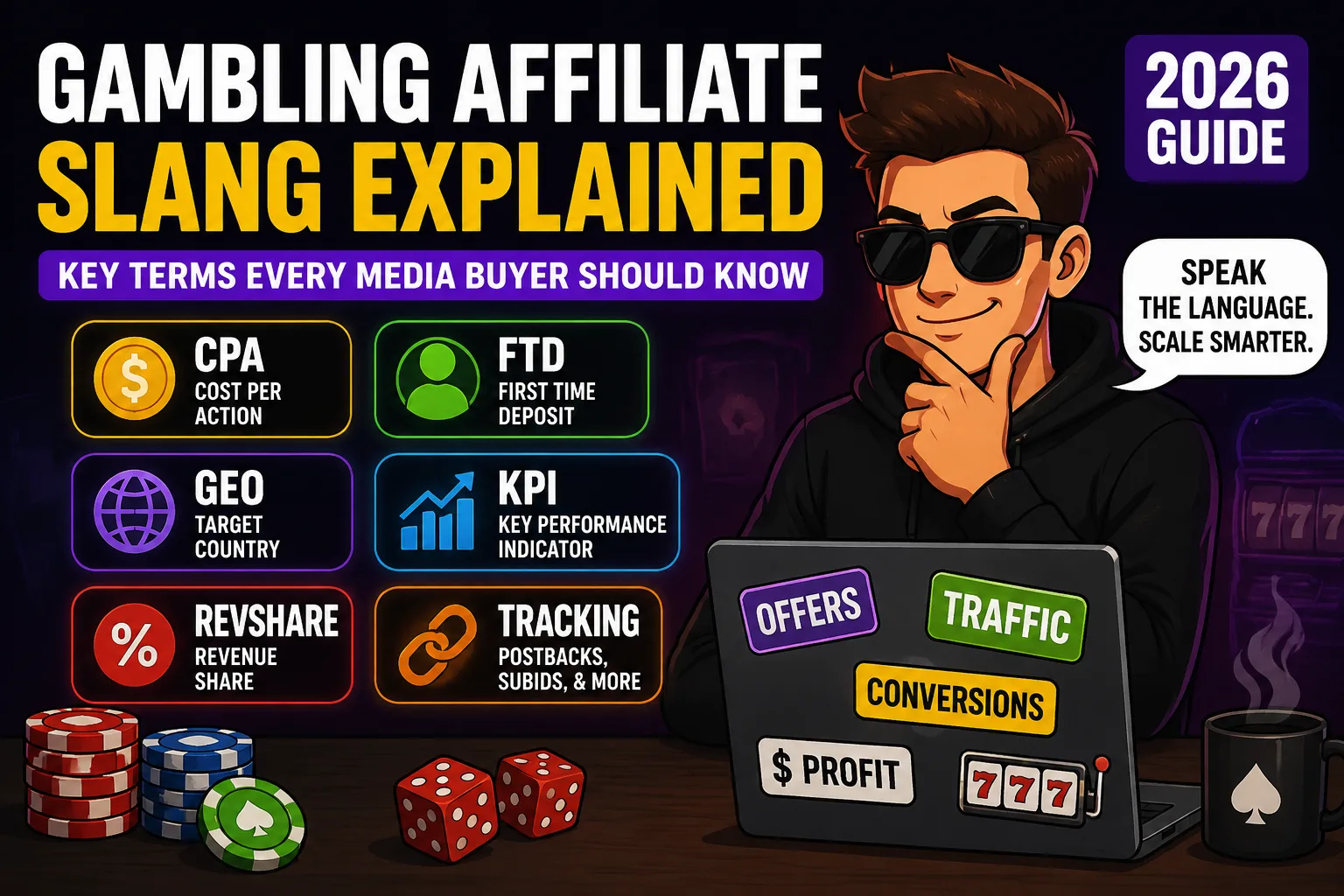
Gambling Affiliate Slang in 2026: Key Terms Every Media Buyer Should Understand
If you are new to gambling affiliate marketing, the first thing you notice is not the traffic, the payouts, or the dashboards. It is the language.
Affiliate managers talk about FTDs, caps, baseline, GEOs, CR, EPC, retention, KPI, white traffic, postbacks, trackers, and sources. For an experienced media buyer, these words are normal working vocabulary. For a beginner, they can feel like a private code.
This guide explains the most useful gambling affiliate slang in a practical way. Instead of listing random abbreviations, we will group the terms by real work situations: choosing an offer, buying traffic, tracking results, checking quality, and avoiding compliance problems in 2026.
Why Gambling Affiliate Slang Matters
Slang in affiliate marketing is not just “industry language.” It helps teams make decisions faster.
When a manager says, “The offer has a high CPA, but the baseline is strict and the cap is limited,” they are not just using abbreviations. They are warning you that the payout may look attractive, but the real conversion path can be harder than expected.
Understanding the vocabulary helps you:
-
compare gambling offers correctly;
-
avoid campaigns with hidden conditions;
-
read statistics without confusion;
-
speak clearly with affiliate managers;
-
understand why traffic may be rejected;
-
reduce mistakes before spending ad budget.
In 2026, this is even more important because gambling traffic is closely connected with platform rules, country regulations, age restrictions, and responsible gambling requirements.
The Money Layer: CPA, RevShare, Hybrid, FTD
Most gambling affiliate terms start with money. Before launching traffic, you need to understand how you will be paid.
CPA
CPA means Cost Per Action. In gambling, the “action” is usually not just a registration. Most often, it is a first deposit or another qualified user action approved by the advertiser.
Example:
If the CPA is $80, the affiliate receives $80 for every player who completes the required action.
Why it matters:
A high CPA does not always mean a better offer. If the deposit requirement is difficult, the conversion rate may be low.
FTD
FTD means First-Time Deposit. This is one of the most important terms in gambling affiliate marketing.
A user becomes an FTD when they register and make their first real-money deposit.
Why it matters:
Many gambling offers pay only after the first deposit, not after a simple sign-up.
RevShare
RevShare means Revenue Share. Instead of receiving one fixed payment, the affiliate earns a percentage of the revenue generated by referred players.
Example:
If the RevShare is 30%, the affiliate receives 30% of the net revenue from referred players.
Why it matters:
RevShare can be more profitable long-term if the players are active and loyal. But it is slower than CPA because revenue builds over time.
Hybrid
Hybrid combines CPA and RevShare.
Example:
An affiliate may receive $40 CPA plus 20% RevShare.
Why it matters:
Hybrid models are useful when you want some immediate cash flow and some long-term earning potential.
Offer Conditions: Baseline, Minimum Deposit, Cap, KPI
Many beginners look only at the payout. Experienced affiliates read the conditions first.
Minimum Deposit
Minimum deposit is the smallest amount a player can deposit on a gambling platform.
Why it matters:
If the minimum deposit is too high for a specific GEO, fewer users will complete the action.
For example, a deposit amount that works in Tier-1 markets may be too expensive for lower-income regions.
Baseline
Baseline is the minimum deposit amount or player value required for the affiliate to receive payment.
Example:
If the baseline is $20, the player may need to deposit at least $20 before the conversion is counted.
There are two common types:
-
cumulative baseline — several deposits can add up to the required amount;
-
single-deposit baseline — the required amount must be deposited at once.
Why it matters:
A single-deposit baseline is usually harder to reach than a cumulative one.
Cap
Cap is the maximum number of conversions accepted by the advertiser during a specific period.
Example:
An offer may have a daily cap of 50 FTDs.
Why it matters:
If you send more conversions than the cap allows, extra conversions may not be paid unless the manager approves them.
KPI
KPI means Key Performance Indicator. In gambling affiliate marketing, KPIs are quality requirements set by the advertiser.
Common gambling KPIs may include:
-
deposit amount;
-
player activity;
-
retention;
-
GEO quality;
-
traffic source;
-
fraud rate;
-
percentage of returning players.
Why it matters:
An offer with a high payout and strict KPI can be riskier than an offer with a lower payout and softer rules.
Traffic Language: GEO, Tier, Source, Pre-Lander
After choosing an offer, the next question is where and how to send traffic.
GEO
GEO means the country or region you target.
Example:
Brazil, Germany, Canada, India, Poland, and Italy are all separate GEOs.
Why it matters:
The same gambling offer can perform differently in different countries because of payment habits, regulations, income level, language, sports culture, and competition.

Tier-1, Tier-2, Tier-3
Tiers are informal market categories.
Tier-1 usually means highly competitive and expensive markets such as the United States, Canada, the United Kingdom, Australia, Germany, and similar regions.
Tier-2 markets are often moderately competitive.
Tier-3 markets usually have cheaper traffic, but conversion quality and payment ability can vary a lot.
Why it matters:
A low-cost click does not always mean cheap conversions. Sometimes Tier-3 traffic is easy to buy but difficult to monetize.
Traffic Source
Traffic source means the platform or channel where users come from.
Common sources include:
-
SEO;
-
PPC;
-
social ads;
-
push notifications;
-
native ads;
-
email;
-
influencer traffic;
-
Telegram traffic;
-
app traffic;
-
direct media buying.
Why it matters:
Some gambling offers accept only specific sources. Always check allowed and forbidden sources before launching.
Pre-Lander
A pre-lander is an intermediate page shown before the final offer page.
It can explain the product, warm up the user, compare options, or prepare the visitor for registration.
Why it matters:
A good pre-lander can improve conversion rate. A misleading pre-lander can create compliance problems and rejected traffic.
Performance Metrics: CTR, CR, EPC, ROI, ROAS
Affiliate marketing is a numbers game. These abbreviations help you understand whether a campaign is profitable.

CTR
CTR means Click-Through Rate.
Formula:
CTR = clicks / impressions × 100%
Example:
If an ad receives 1,000 impressions and 30 clicks, the CTR is 3%.
Why it matters:
CTR shows how attractive your creative is. A low CTR may mean the ad does not catch attention or the audience is wrong.
CR
CR means Conversion Rate.
Formula:
CR = conversions / clicks × 100%
Example:
If 100 users click and 5 become FTDs, the CR is 5%.
Why it matters:
CR shows how well traffic converts after the click.
EPC
EPC means Earnings Per Click.
Formula:
EPC = revenue / clicks
Example:
If you earn $200 from 400 clicks, your EPC is $0.50.
Why it matters:
EPC helps compare campaigns with different payouts and conversion rates.
ROI
ROI means Return on Investment.
Formula:
ROI = profit / ad spend × 100%
Example:
If you spend $500 and earn $650, your profit is $150.
ROI = $150 / $500 × 100% = 30%.
Why it matters:
ROI shows whether the campaign is actually profitable.
ROAS
ROAS means Return on Ad Spend.
Formula:
ROAS = revenue / ad spend
Example:
If you spend $500 and earn $1,000, ROAS is 2.0.
Why it matters:
ROAS is useful for quick advertising performance checks, but ROI is better for understanding real profit.
Tracking Terms: Tracker, Postback, SubID, Attribution
Without tracking, gambling affiliate marketing becomes guesswork.
Tracker
A tracker is a tool that records clicks, conversions, traffic sources, devices, GEOs, creatives, and campaign performance.
Why it matters:
A tracker helps you see which campaign, ad, placement, or keyword brings real conversions.
Postback
Postback is a server-to-server signal that sends conversion data from the affiliate network or advertiser back to your tracker.
Why it matters:
Postback allows you to see which click turned into a conversion.
SubID
SubID is a tracking parameter added to a link.
Example:
You can use SubIDs to mark campaign name, creative ID, ad set, placement, or keyword.
Why it matters:
SubIDs help you understand which part of the campaign works and which part wastes budget.
Attribution
Attribution is the process of deciding which click, source, or campaign gets credit for a conversion.
Why it matters:
In gambling, users may click several ads before depositing. Attribution helps decide which touchpoint should receive credit.
Quality and Risk Terms: Fraud, Bot Traffic, Chargeback, Scrub
Not all conversions are equal. Advertisers care about traffic quality.
Fraud
Fraud means fake, manipulated, or invalid activity.
Examples may include fake registrations, bot clicks, stolen payment data, or artificially created leads.
Why it matters:
Fraud can lead to rejected conversions, unpaid commissions, blocked accounts, and long-term reputation damage.
Bot Traffic
Bot traffic is traffic generated by automated scripts instead of real users.
Why it matters:
Bots may create clicks or registrations, but they do not become real players. This damages campaign quality.
Chargeback
Chargeback happens when a payment is reversed by the bank or payment provider.
Why it matters:
High chargeback rates can make the advertiser reject traffic or reduce trust in the affiliate.
Scrub
Scrub means the advertiser or network removes invalid or low-quality conversions from the final payable result.
Why it matters:
Some scrub is normal when traffic quality is checked. But if the scrub rate is high, you need to review your source, targeting, and offer conditions.
Compliance Slang in 2026: What to Treat Carefully
Gambling is a restricted advertising category. In 2026, platforms, regulators, and advertisers pay more attention to compliance, licensing, age protection, and responsible gambling messages.
This means affiliates should be careful with any slang connected to risky or non-compliant promotion.
White Page and Black Page
In affiliate slang, these terms are often used to describe different versions of a page shown to different audiences.
Important note:
Using different pages to mislead platforms, reviewers, or users can violate advertising policies and lead to account bans.
Practical recommendation:
Build compliant funnels instead of relying on risky shortcuts.
Whitelist and Blacklist
Whitelist usually means a list of approved placements, sources, apps, websites, or audiences.
Blacklist means a list of blocked placements, sources, apps, bots, or poor-quality traffic segments.
Why it matters:
A good whitelist can help scale profitable traffic. A strong blacklist helps cut waste and reduce fraud.
Restricted GEO
A restricted GEO is a country or region where the offer cannot be promoted or where gambling advertising requires special approval.
Why it matters:
Sending traffic from restricted countries can result in rejected commissions and compliance issues.
People in the Workflow: Affiliate, Advertiser, Network, Manager
Gambling affiliate marketing involves several roles.
Affiliate
An affiliate is the person or company that sends traffic to an offer and earns commission for approved actions.
In slang, affiliates may also be called publishers, webmasters, or media buyers.
Advertiser
The advertiser is the gambling brand, operator, or product owner that pays for traffic.
Why it matters:
The advertiser sets the offer rules, KPI, allowed GEOs, payment model, and traffic restrictions.
Affiliate Network
An affiliate network connects affiliates and advertisers.
It provides offers, tracking, payments, support, and sometimes creative materials.
Why it matters:
A good network helps affiliates understand offer conditions and avoid bad traffic decisions.
Affiliate Manager
An affiliate manager supports affiliates, explains offer rules, gives updates, approves caps, and may suggest better GEOs or sources.
Why it matters:
A good manager can save you money by warning you before you launch the wrong campaign.
How to Read a Gambling Offer Card
Before launching a campaign, check the offer card like a checklist.
Look at:
-
GEO
Which countries are allowed? -
Payment model
CPA, RevShare, Hybrid, CPL, or another model? -
Conversion action
Registration, FTD, deposit amount, active player, or qualified lead? -
Minimum deposit
Is the amount realistic for the target market? -
Baseline
Is it cumulative or single-deposit? -
Cap
How many conversions are accepted per day or week? -
Allowed sources
Can you use social ads, PPC, SEO, push, native, email, apps, or influencers? -
Restricted sources
Are any channels banned? -
KPI
What traffic quality rules must be met? -
Payment terms
When and how are commissions paid?
Beginner insight:
If the payout looks much higher than similar offers, check the conditions twice. The offer may have stricter KPI, harder deposit requirements, limited GEOs, or lower approval rates.
Mini Glossary by Real Situation
When You Choose an Offer
-
Offer — the gambling product you promote.
-
Payout — how much you earn per approved action.
-
CPA — fixed payment per action.
-
RevShare — percentage of revenue from referred players.
-
Hybrid — combination of fixed payment and revenue share.
-
FTD — first-time deposit.
-
Baseline — minimum required player value.
-
KPI — quality requirements.
When You Buy Traffic
-
GEO — target country or region.
-
Source — traffic channel.
-
Creative — ad image, video, text, or concept.
-
Pre-lander — page before the final offer.
-
Landing page — final page where the user registers or deposits.
-
Cap — maximum accepted conversions.
When You Analyze Results
-
CTR — percentage of impressions that become clicks.
-
CR — percentage of clicks that become conversions.
-
EPC — earnings per click.
-
ROI — profit compared with ad spend.
-
ROAS — revenue compared with ad spend.
-
Tracker — tool for campaign analytics.
-
Postback — conversion signal sent to your tracker.
-
SubID — tracking parameter for campaign details.
When You Check Traffic Quality
-
Fraud — fake or invalid activity.
-
Bot traffic — non-human traffic.
-
Chargeback — reversed payment.
-
Scrub — removed invalid conversions.
-
Retention — how long players stay active.
-
LTV — lifetime value of a player.
Practical Example: How Slang Works in One Conversation
Imagine an affiliate manager says:
“This offer works well in Brazil. CPA is $90, FTD-based. Minimum deposit is low, but baseline is $20 cumulative. Cap is 30 FTDs per day. Push and native are allowed. KPI is focused on retention and fraud rate. Use postback and pass SubIDs for creatives.”
For a beginner, this may sound complicated. But translated into plain English, it means:
You can promote a gambling offer in Brazil. You will earn $90 for each approved first-time depositor. The player must deposit at least $20 in total, but it can be done through more than one payment. You can bring up to 30 conversions per day. Push and native ads are allowed. The advertiser will check whether users are real, active, and not fraudulent. You should set up tracking correctly before launch.
This is why knowing the terminology matters. It turns a confusing offer description into a clear business decision.
Conclusion
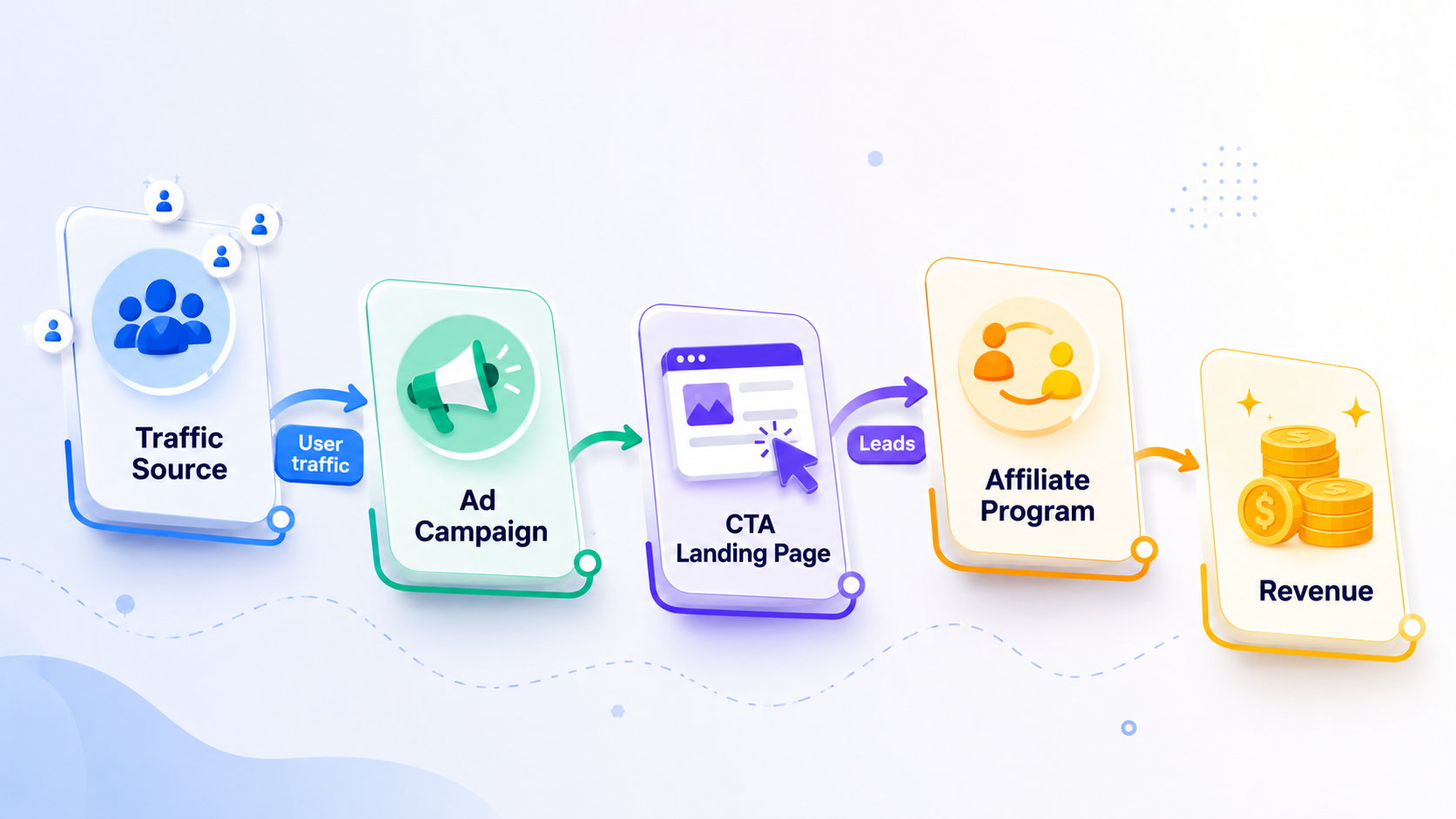
Gambling affiliate slang is not just a list of abbreviations. It is the working language of offers, traffic, tracking, payments, and risk.
If you are new to the niche, start with the most important groups:
-
money terms: CPA, RevShare, Hybrid, FTD;
-
offer terms: baseline, cap, KPI, minimum deposit;
-
traffic terms: GEO, source, creative, pre-lander;
-
analytics terms: CTR, CR, EPC, ROI, ROAS;
-
tracking terms: tracker, postback, SubID;
-
quality terms: fraud, scrub, chargeback, retention.
The better you understand these terms, the easier it becomes to compare offers, ask the right questions, protect your budget, and build campaigns that are not only profitable but also sustainable in 2026.