
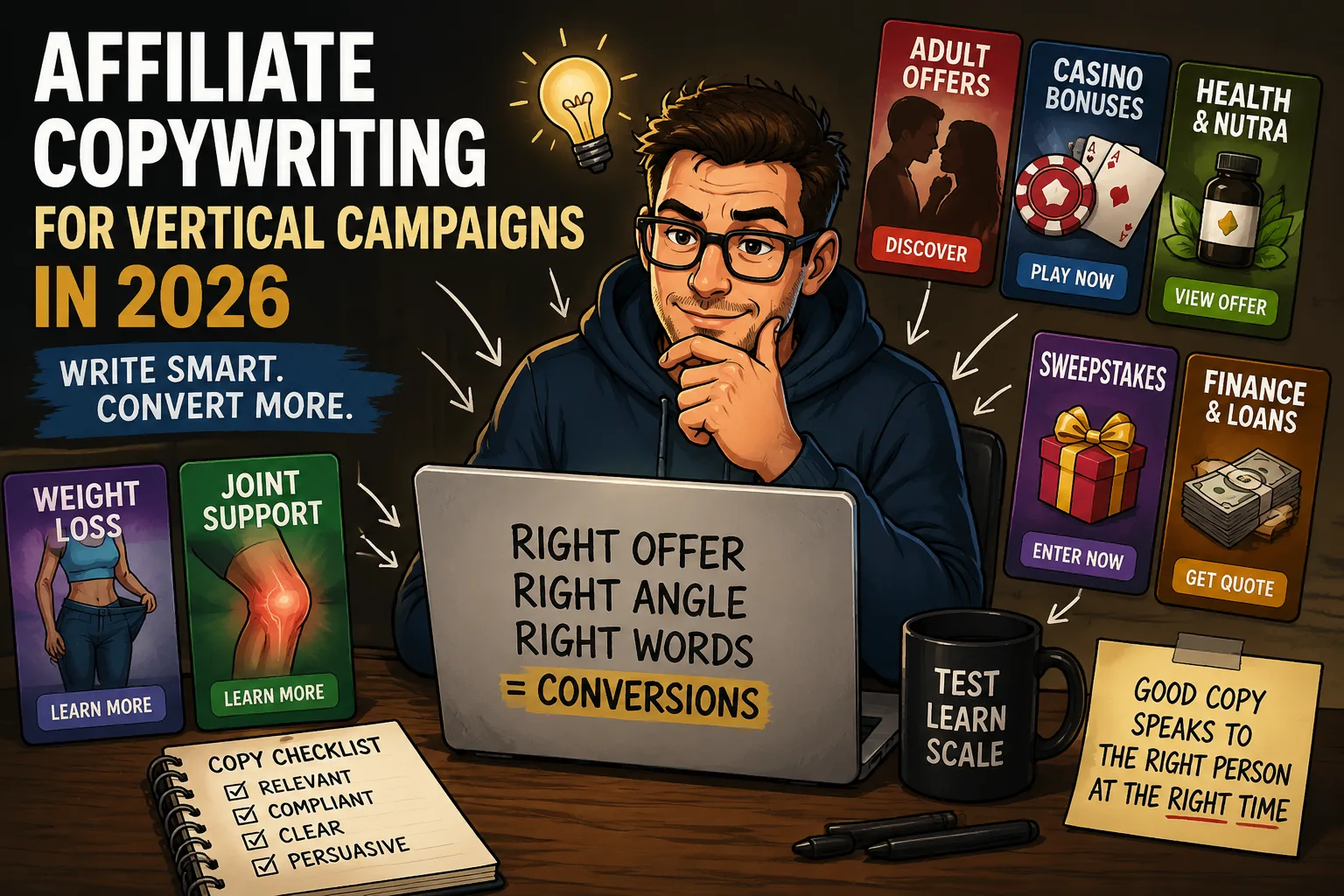
Affiliate Copywriting by Vertical: How to Build Ad Texts That Convert in 2026
Affiliate marketing has changed. A few years ago, many media buyers could launch campaigns with aggressive headlines, emotional triggers, and ready-made text blocks copied from public examples. In 2026, that approach is weaker and riskier.
Ad platforms review language more strictly, users recognize generic promises faster, and affiliate teams need copy that does more than grab attention. Good ad text must match the offer, the traffic source, the landing page, and the user’s level of awareness.
This guide explains how to write affiliate ad copy for different verticals without relying on copied templates. Instead of giving random phrases, we’ll break down the logic behind high-performing texts: what to say, what to avoid, and how to adapt your message for health, adult, beauty, finance, gambling, sweepstakes, and other popular CPA niches.
Why Vertical-Based Copy Still Matters
Every affiliate vertical has its own emotional driver.
A person clicking on a weight loss offer does not think like someone clicking on a gambling bonus. A user interested in joint support has different doubts than someone looking for an adult product. That is why one universal ad template rarely works across multiple niches.
Vertical-based copy helps you answer three questions before writing:
-
What problem or desire brings the user into the funnel?
-
What level of trust does this niche require?
-
What type of language can pass moderation and still create interest?
In 2026, this is especially important for regulated or sensitive categories. Health-related offers, financial products, adult content, and gambling campaigns need more careful wording than general e-commerce or entertainment ads.
The goal is not to hide the offer. The goal is to frame it in a way that feels relevant, believable, and aligned with platform rules.
The 2026 Copywriting Formula for Affiliate Offers
Before writing any ad text, build a simple copy map. It should include four elements:
1. The user state
This is the situation the user recognizes.
Examples:
-
“I want more confidence.”
-
“I want to feel lighter.”
-
“I want to compare options before buying.”
-
“I am curious about a bonus.”
-
“I need a simple solution without wasting time.”
This is not the same as directly accusing the user of having a problem. On platforms like Meta, ad copy should avoid implying that you know personal attributes, medical conditions, financial status, or private issues about the viewer.
Better approach:
“Many people look for a simpler way to compare wellness options.”
Riskier approach:
“Are you overweight and tired of your body?”
The first version speaks broadly. The second version targets a sensitive personal attribute.
2. The offer angle
The angle is the main reason to click. It can be built around:
-
convenience;
-
curiosity;
-
comparison;
-
savings;
-
expert explanation;
-
privacy;
-
new routine;
-
limited availability;
-
bonus value.
For affiliate campaigns, the angle often matters more than the product itself. Two affiliates can promote the same offer, but the one with the sharper angle usually gets cheaper clicks and better pre-lander engagement.
3. The proof layer
Users are tired of impossible promises. A strong text needs a trust signal.
Depending on the vertical, this can be:
-
ingredient explanation;
-
product comparison;
-
user guide;
-
transparent pricing;
-
clear terms;
-
expert review;
-
step-by-step process;
-
realistic expectations.
Avoid fake medical authority, fake celebrity claims, fake reviews, and “guaranteed result” language. In 2026, this is not only a moderation risk but also a conversion problem. Users are more skeptical than before.
4. The next step
Affiliate ad copy should not try to sell everything in one sentence. Its job is to move the user to the next stage of the funnel.
Good CTA examples:
-
“See how it works”
-
“Compare available options”
-
“Check today’s offer”
-
“Read the short guide”
-
“View the details”
-
“Find out what’s included”
Overpromising in the CTA can hurt both moderation and landing page trust.
Health and Nutra Offers: Trust Beats Shock
Health and nutra remain popular affiliate verticals, but they are also among the most sensitive. This includes products around blood pressure, diabetes, joints, vision, parasites, weight loss, sleep, men’s wellness, and supplements.
The biggest mistake is writing like a miracle cure.
Avoid phrases that promise:
-
instant recovery;
-
permanent results;
-
medical treatment without a doctor;
-
guaranteed weight loss;
-
disease reversal;
-
replacement for medication.
A safer and more effective approach is to focus on education, routine, and comparison.
Better copy angles for health-related offers
Educational angle:
“Simple daily habits people often overlook when building a wellness routine.”
Comparison angle:
“Compare popular support products and see what makes each formula different.”
Routine angle:
“A practical guide to adding wellness support into your day without complicated steps.”
Curiosity angle:
“Why are more people paying attention to this ingredient category?”
Trust angle:
“Learn what to check before choosing a supplement online.”
These angles create interest without making direct medical promises.
Practical tip
For health campaigns, the pre-lander should continue the same cautious tone. If the ad is moderate but the landing page promises a “100% cure,” the campaign can still fail review or lose user trust.
Adult and Relationship Offers: Confidence, Privacy, and Curiosity
Adult-related affiliate offers often rely on strong emotional triggers. But aggressive or explicit language can quickly create moderation problems, especially on mainstream traffic sources.
Instead of writing crude promises, build copy around confidence, privacy, relationship energy, and curiosity.
Safer adult copy directions
Confidence angle:
“Small changes that can help adults feel more confident in private life.”
Privacy angle:
“Discreet options for people who prefer to keep personal purchases private.”
Curiosity angle:
“Why are men comparing this type of product before choosing one?”
Lifestyle angle:
“Personal care is not only about appearance — confidence matters too.”
This type of copy can still attract the right audience, but it avoids overly direct claims and explicit wording.
Practical tip
Make sure the creative, text, and landing page match. If the ad looks like a serious wellness guide but the landing page is extremely explicit, users may bounce. Consistency across the funnel improves conversion quality.
Weight Loss, Beauty, and Body-Related Offers: Avoid Shame-Based Messaging
Weight loss and beauty campaigns often fail because they attack the user’s appearance. This may get attention, but it can also trigger rejection and reduce trust.
Avoid:
-
“Are you ashamed of your body?”
-
“Get rid of fat fast”
-
“Look 20 years younger”
-
“Perfect body in 7 days”
-
before/after certainty;
-
unrealistic numbers.
A better approach is to write around comfort, routine, confidence, and product discovery.
Stronger copy examples
“Explore simple wellness products people add to their daily routine.”
“Compare popular beauty formulas before choosing your next skincare product.”
“A practical guide to building a body-care routine without extreme promises.”
“Looking for a lighter daily routine? Start with the basics.”
The text is still commercial, but it sounds more credible.
Practical tip
In body-related verticals, the best copy often feels less like pressure and more like a guide. Users want to feel that they are making a choice, not being manipulated.
Gambling and Casino Offers: Sell Entertainment, Not Guaranteed Wins
Gambling and casino affiliate campaigns need a different mindset. The emotional driver is excitement, but copy must avoid implying guaranteed income or easy money.
Bad angle:
“Win money today with no risk.”
Better angle:
“Explore available casino bonuses and compare what each offer includes.”
For gambling-related copy, focus on:
-
bonus terms;
-
entertainment value;
-
game variety;
-
registration process;
-
payment methods;
-
responsible play;
-
comparison of offers.
Example copy directions
“Compare today’s casino bonus options before choosing where to play.”
“See what this welcome offer includes and check the terms before signing up.”
“Looking for new online games? Start with a quick overview of available options.”
“Explore casino platforms with clear bonus rules and simple navigation.”
Practical tip
Do not hide important terms. If a bonus has wagering requirements, geographic restrictions, or age limitations, the landing page should make that clear. Transparent funnels may convert fewer random clicks but often produce better-quality leads.
Finance and Lead Generation: Clarity Converts Better Than Hype
Finance, insurance, loans, credit repair, and investment-related offers are high-value verticals, but users are cautious. They need clarity before they submit personal data.
Copy should answer:
-
What is being compared?
-
Is it free to check?
-
What information is needed?
-
Are there eligibility conditions?
-
What happens after the form is submitted?
Avoid income guarantees, fake urgency, and unrealistic approval claims.
Better finance copy angles
“Compare available options before submitting an application.”
“Check what factors may affect eligibility.”
“See a simple overview before choosing a financial product.”
“Find out what information is usually required before applying.”
For lead generation, trust is the conversion trigger. The more sensitive the user data, the clearer the copy must be.
Sweepstakes and Freebie Offers: Curiosity With Clear Expectations
Sweepstakes, giveaways, and freebie campaigns often rely on curiosity. But vague or misleading copy can create poor traffic quality.
Instead of “You have won,” use language that explains the action honestly.
Better options:
-
“Enter for a chance to participate”
-
“See how the promotion works”
-
“Check today’s available giveaway”
-
“View eligibility details”
-
“Complete the short form to join”
This keeps the message attractive without creating a false impression.
Practical tip
Sweepstakes funnels work best when the ad, form, and confirmation page are aligned. If users expect an instant prize but land on a multi-step form, conversion quality will drop.
How to Turn One Offer Into Multiple Ad Texts
A strong affiliate team does not write one headline and hope it works. It creates several angles and tests them.
For each offer, prepare at least five copy variations:
1. Problem-aware version
Focus on the general situation.
Example:
“Many people want a simpler way to compare wellness products before buying.”
2. Curiosity version
Create interest without revealing everything.
Example:
“Why are more users checking this type of formula in 2026?”
3. Comparison version
Useful for review-style funnels.
Example:
“Compare popular options and see what fits your routine.”
4. Trust version
Good for sensitive verticals.
Example:
“Before choosing a product, check the key details most buyers overlook.”
5. Action version
More direct and CTA-focused.
Example:
“View the offer details and see what is available today.”
This method gives you more testing material without copying random templates from competitors.
Copywriting Checklist Before Launch
Before uploading ads, review your text through this checklist:
-
Does the copy match the landing page?
-
Is the main promise realistic?
-
Does it avoid direct personal accusations?
-
Does it avoid guaranteed medical, financial, or body-related results?
-
Is the CTA clear?
-
Is the offer understandable within a few seconds?
-
Does the copy create curiosity without misleading the user?
-
Are disclosures, terms, or limitations visible where needed?
-
Does the text sound natural in the target GEO language?
-
Can this angle be tested in multiple creative formats?
This simple review can save budget, reduce rejections, and improve campaign stability.
Example: How to Build Copy for a Health Support Offer
Let’s say you promote a supplement-style offer in a health-related vertical.
Weak copy:
“Cure your problem forever with this miracle product.”
Better structure:
Headline:
“Compare Daily Wellness Support Options”
Primary text:
“Looking for a simple addition to your routine? Learn what to check before choosing a supplement online.”
CTA:
“View the guide”
Why this works:
-
It does not promise a cure.
-
It does not diagnose the user.
-
It creates a reason to click.
-
It fits a pre-lander or review-style landing page.
-
It can be adapted for multiple GEOs.
Example: How to Build Copy for a Casino Bonus Offer
Weak copy:
“Win real money today with this secret casino.”
Better structure:
Headline:
“Compare Today’s Casino Bonus Options”
Primary text:
“See what the welcome offer includes, check the terms, and choose where to start playing.”
CTA:
“Check details”
Why this works:
-
It focuses on comparison.
-
It avoids guaranteed winning claims.
-
It sets realistic expectations.
-
It prepares the user to read the bonus conditions.
Final Thoughts
Ready-made texts can be useful as inspiration, but they should not become the foundation of your affiliate campaigns. In 2026, stronger results come from understanding the vertical, the user’s motivation, and the platform rules.
The best affiliate copy is not the loudest. It is the clearest, most relevant, and easiest to connect with the next step in the funnel.
Use this simple process:
Choose the vertical.
Define the user state.
Pick the safest strong angle.
Add a trust signal.
Write several variations.
Test them against real campaign data.
Example: for a joint support offer, do not write “Remove pain forever.” Write a comparison-style ad that invites users to learn what to check before choosing a daily support product. That small shift can make the copy more credible, more platform-friendly, and more useful for the user.